Backtester
Updated: 2026-11-14
The backtester replays a strategy over market history that has already happened and trades virtual money. In minutes you see what live trading would take weeks to show, without risking a cent. Most first ideas fail here, and that’s the point: an idea killed on history costs you nothing.
It is one backtester for every market you can automate:
- Up/Down — Polymarket crypto Up/Down contracts (BTC, ETH, SOL and others; 5-minute to daily windows).
- Crypto — spot and perpetual futures pairs on exchanges, such as BTCUSDT.
- Stocks & derivatives — stocks and ETFs through brokers.
A market switch at the top filters everything: the registry, new runs and comparisons.
Where to find it
Open Backtester from the main menu. It is also a window on the Algo trading desk, and the Backtests item in Algo trading opens it for your market.
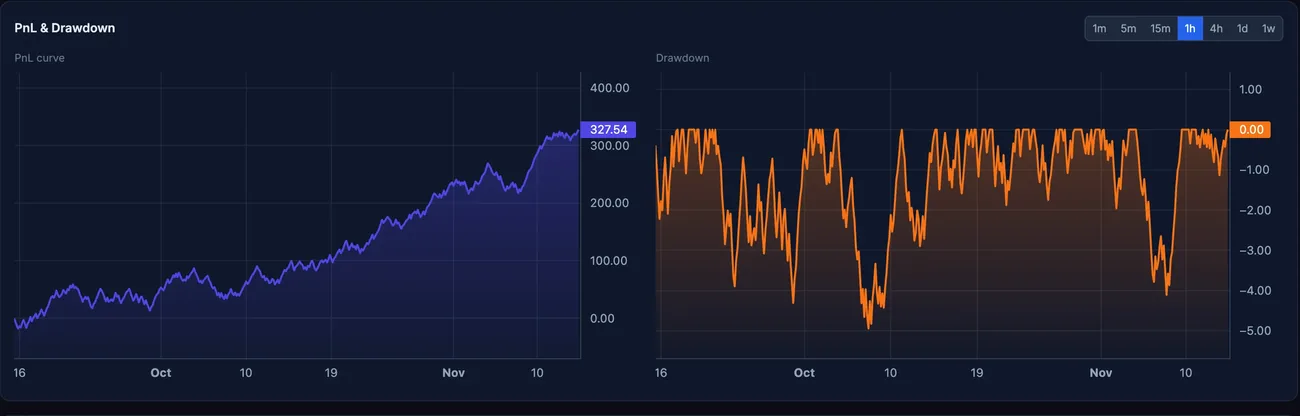 The profit curve (left) and drawdown (right) of one run. Demo numbers illustrate the mechanics, not expected returns.
What a run gives you
Every run produces far more than one profit number:
- Results — net P&L after fees, win rate, profit factor, max drawdown, Sharpe and Sortino, plus statistics that tell you whether the sample is big enough (edge per trade with a confidence interval, PSR, DSR).
- Trades — every trade with entry and exit, fees, the reason it closed and the indicator values at entry. A trade card shows exactly why the entry fired.
- Validation — Monte Carlo resampling, order shuffles and significance tests answer “skill or luck?”. Crypto and stock runs also get a train/test split and the strategy gates.
- Analytics — where the edge lives: entry-price calibration for Up/Down, P&L by hour, weekday, ticker and market regime, and a risk panel for crypto and stocks.
The same engine as your bots
For Up/Down, the backtester runs the same trading engine that powers paper and live bots, fed with history instead of the live feed. For crypto and stocks, runs use the same strategy engine as Multimarket bots, with fees and slippage built in. A strategy you tested is the strategy your bot executes.
From strategy to bot
The backtester is the middle of a simple path:
- Strategy. Build one in the constructor, start from a library template, or load a saved one. See Strategy builders and indicators.
- Full backtest. Run it on enough history, read Results, Validation and Analytics. For crypto and stocks, pass the strategy check.
- Bot. Approve the version you trust and create a bot from it. The bot starts in paper mode; going live always needs your explicit confirmation.
Each strategy has a single card that collects its versions, runs, readiness summary and bots, so you can always see where an idea stands. See Registry, strategies and comparison.
Compare and iterate
Tick two or more runs and compare them side by side: overlaid equity curves, a delta table of metrics, the strategy parameters that differ, and a correlation matrix. It’s the quickest way to answer “is the tighter stop actually better?”.
AI help
Gogo Adviser sits on every Up/Down result. It reads the run and explains in plain language what drives performance and where the weak spots are, for example that all the profit came from one week or only works at certain hours. You can ask follow-ups or apply its suggestion as a new run. Treat it as a second pair of eyes, not a verdict.
Limits and honest caveats
- A backtest answers “does this strategy have a statistical edge that survives fees?”, not “will I make money?”. Past results don’t guarantee future ones.
- Fills are simulated. Live trading has thinner liquidity, slippage and outages, so live drawdowns usually run deeper than backtested ones.
- Up/Down runs cover up to 365 days per run. How many runs you can have queued or running at once depends on your plan.
- Never decide from a run with zero fees.