Checklist before a bot
Updated: 2026-11-14
A backtest is evidence about one configuration on one market over one period. This page turns everything in the backtester into a routine: what to check, in what order, and what to avoid.
The evaluation ladder
Climb one step at a time. If a step fails, fix the strategy or drop the idea and rerun. Don’t skip ahead.
- A. Does it earn? Results: total P&L above zero with realistic fees; average per trade clearly above the average fee per trade. For crypto and stocks, also better than buy & hold, or a clear reason why not (lower drawdown, less time in the market).
- B. Is there enough data? Up/Down: the edge interval clear of zero, actual trades above “Trades needed”, PSR above 90%. Crypto and stocks: a period long enough that the “short period” warning is gone, and enough closed trades. Too few trades? Don’t tune; lengthen the window.
- C. Skill, not luck? Validation: robust or acceptable, not clustered, SIGNIFICANT.
- D. Not curve-fitting? DSR holds up against all your attempts, and the same configuration on another window keeps the sign of its edge. For crypto and stocks: profitable on the test part of Train / test, and the strategy check passes the robustness gate.
Passed all four? The strategy has earned a paper bot. The path is Strategy → Backtest → Validation → Paper → Live. Every step you skip is a bill the market sends later.
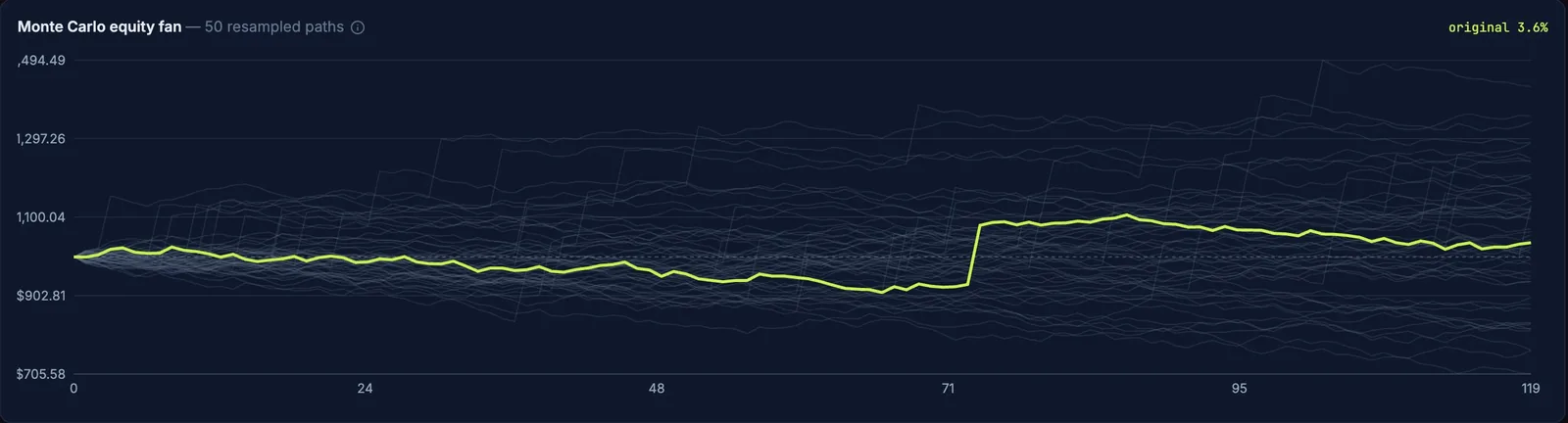 Why curve shape matters: the bold real curve made almost all of its 3.6% in one jump, and many resampled paths end below the start. Demo data.
Ten common mistakes
- Conclusions from 20 trades. That’s noise, not a result. Lengthen the window.
- Zero fees “to see the potential”. A real case: +26% over 90 days without fees became a deep loss with honest fees, same strategy and window.
- Win rate instead of edge. Buying at 0.70, a random strategy wins about 70% of the time and still loses on fees. Compare win rate with entry price (calibration).
- Fishing for parameters until it looks good. The best of 30 random tries is bound to look good. Watch DSR, and use the plateau test in the strategy check.
- Five changes at once. You’ll never know what worked. One or two targeted changes per run, each tied to a diagnosis.
- Ignoring curve shape. Profit from two spikes is not a strategy.
- No drawdown limits. Without a fuse, a bad run rides to −100% of virtual capital, and a bad live bot to numbers you don’t want to see. Set Circuit breakers in Up/Down strategies and a drawdown stop on every bot.
- Skipping paper. A backtest doesn’t know live liquidity or your real fills.
- Expecting live to repeat the backtest drawdown. It will be deeper. Budget for 1.5–2×.
- Testing on a convenient slice. Verified only during a rally means a bet on the rally. Use different windows, the regime breakdown and, for crypto and stocks, a batch over several tickers.
The checklist
Before you press Approve on the strategy card:
- Total P&L above zero at realistic fees (not 0%).
- Average per trade clearly above the average fee per trade.
- Profit factor of 1.5 or more, with a win rate that makes sense for your entry price.
- You can sit through 1.5–2× the backtest drawdown with real money.
- Enough trades: “Trades needed” below actual, PSR above 90% (Up/Down).
- DSR holds up against your history of attempts.
- Validation: robust or acceptable, not clustered, p < 0.05.
- Up/Down: the edge lives in sensible price ranges; losing ranges are filtered out.
- Crypto and stocks: profitable on unseen data (Train / test), and the strategy check says Can go to paper.
- The curve is a steady staircase, not two spikes.
After approval
- Create bot from vN on the strategy card. The bot gets a frozen copy of that version.
- Run it on paper. For crypto and stocks the strategy check wants at least 14 days, with the paper result within 2 percentage points of the backtest of the same period.
- Check Bot vs backtest. A bot that tracks its backtest is ready to be considered for live; one that diverges needs a closer look at execution, fees and data first.
- Going live is always your explicit decision and needs a separate confirmation. Set a drawdown stop for the bot.
And remember: most cycles honestly end with “no edge, drop the idea”. That’s a good outcome. It cost you nothing.