Polymarket legs in a combination
Updated: 2026-11-14
Polymarket lists markets on crypto prices, such as “Will Bitcoin reach $90,000 in October?” or “Bitcoin above ___ on October 30?”. Each of these is a binary bet on the same price your options depend on. The Position builder lets you add them as legs next to options and the perp, and draws the whole thing on one chart.
That opens up trades you can’t easily build anywhere else. You can sell an expensive out-of-the-money call through Polymarket instead of the options book, or pay for a call with a “No” that wins if the price stays calm. You can also check whether a Polymarket price is cheap or rich against what the options market implies.
Adding a Polymarket leg
- In the builder, open Add → Leg… and pick Polymarket markets on BTC (or your coin).
- The Add Polymarket picker lists open Polymarket events on the coin’s price, grouped as on polymarket.com. You can search, paste a
polymarket.com/event/…link, or filter by type (Above / below, Hit price, Price range) and period (Hourly, Daily, Weekly, Monthly, Yearly). - Set the Amount in shares or dollars.
- Click a Yes or No price. A new leg is added at the best ask.
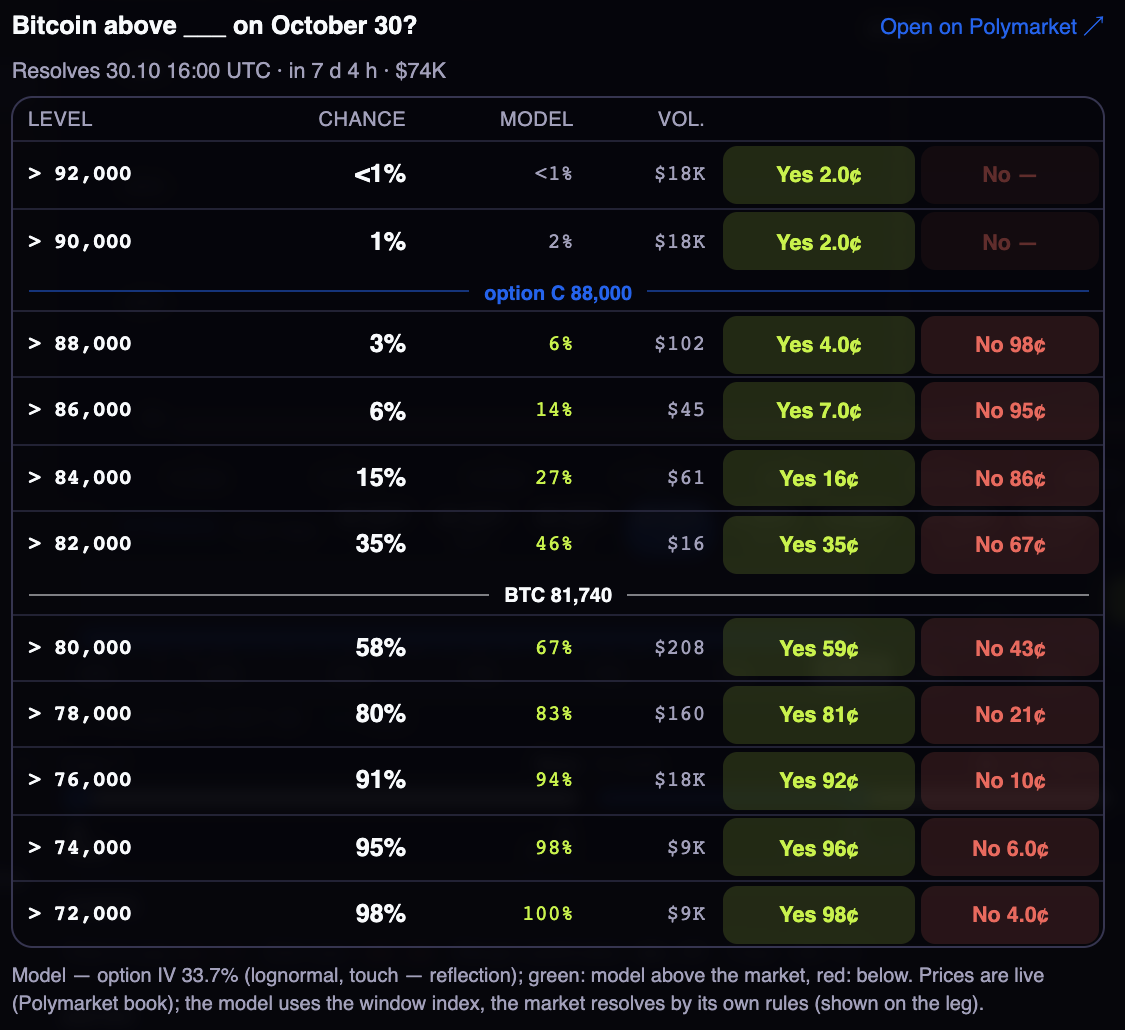 Each level shows the market’s chance, the builder’s model chance, volume, and live Yes/No asks. The blue line marks where your 88,000 call sits, and the white line marks the current price.
Read the picker like this. For “> 84,000 on October 30”, the market says 15% (Yes costs 16¢, No costs 86¢). The options market, through the model, says 27%. Green model figures mean the model is above the market: by option prices, Yes looks cheap here. Red would mean the opposite. This tells you where the two markets disagree. It doesn’t tell you which one is right.
Under each event the picker also tells you how its timing fits your options. “Resolves together with the window’s options” is the best fit. “Resolves 2 d after the options expire” means there is a window without a hedge.
You can also load Polymarket positions you already hold through From portfolio → Polymarket. Only markets on the coin’s price can be loaded.
How the builder prices a Polymarket leg
A Polymarket share pays $1 if its outcome wins and $0 if it doesn’t. The builder turns each market into one of three payoff types:
| Type | Example question | Pays $1 on “Yes” if… |
|---|---|---|
| Price on date | “Bitcoin above $84,000 on October 30?” | the price is above (or below) K at the resolution time |
| Range | “Bitcoin between $80,000 and $82,000 on…?” | the price ends inside the range |
| Touch | “Will Bitcoin reach $90,000 in October?” | the price touches K at any moment before resolution |
“No” pays the opposite. The builder reads the type, level and date from the market’s question and rules, and shows them on the leg. For positions loaded from your wallet, you confirm or correct them.
To value the leg before resolution, the builder uses the same option model as for the coin’s options. “Price on date” works like a digital option, and “Touch” uses the chance of the price crossing the level at any time. It picks the volatility that makes the model match the market’s own price today. If that doesn’t work, it uses the window’s at-the-money option IV.
Two things the model can’t know:
- The resolution source. A market may resolve on a specific exchange’s candle or price field. The model uses the window’s index. The leg shows the market’s rule, for example “rules: … · resolves 30.10 16:00 UTC”.
- The end date shown on Polymarket is not always the resolution moment. The builder shows the resolution time from the market rules.
Fees: Polymarket’s taker fee for the market is included in the leg’s costs.
Worked example: a call financed by “No”
The example position is a BTC call plus two “No” positions on touch markets, all already held, with BTC at 81,740. The options expire on 30 Oct at 08:00 UTC. Both Polymarket markets resolve on 1 Nov at 04:00 UTC.
| Leg | Size | Entry | Cost |
|---|---|---|---|
| Buy 30 OCT 26 88,000 call | 0.5 BTC | $230.31 | $115.16 |
| Buy “No” on “Will Bitcoin reach $90,000 in October?” | 1,000 shares | 87¢ | $870.00 |
| Buy “No” on “Will Bitcoin reach $100,000 in October?” | 55.38 shares | 90¢ | $49.84 |
The call alone
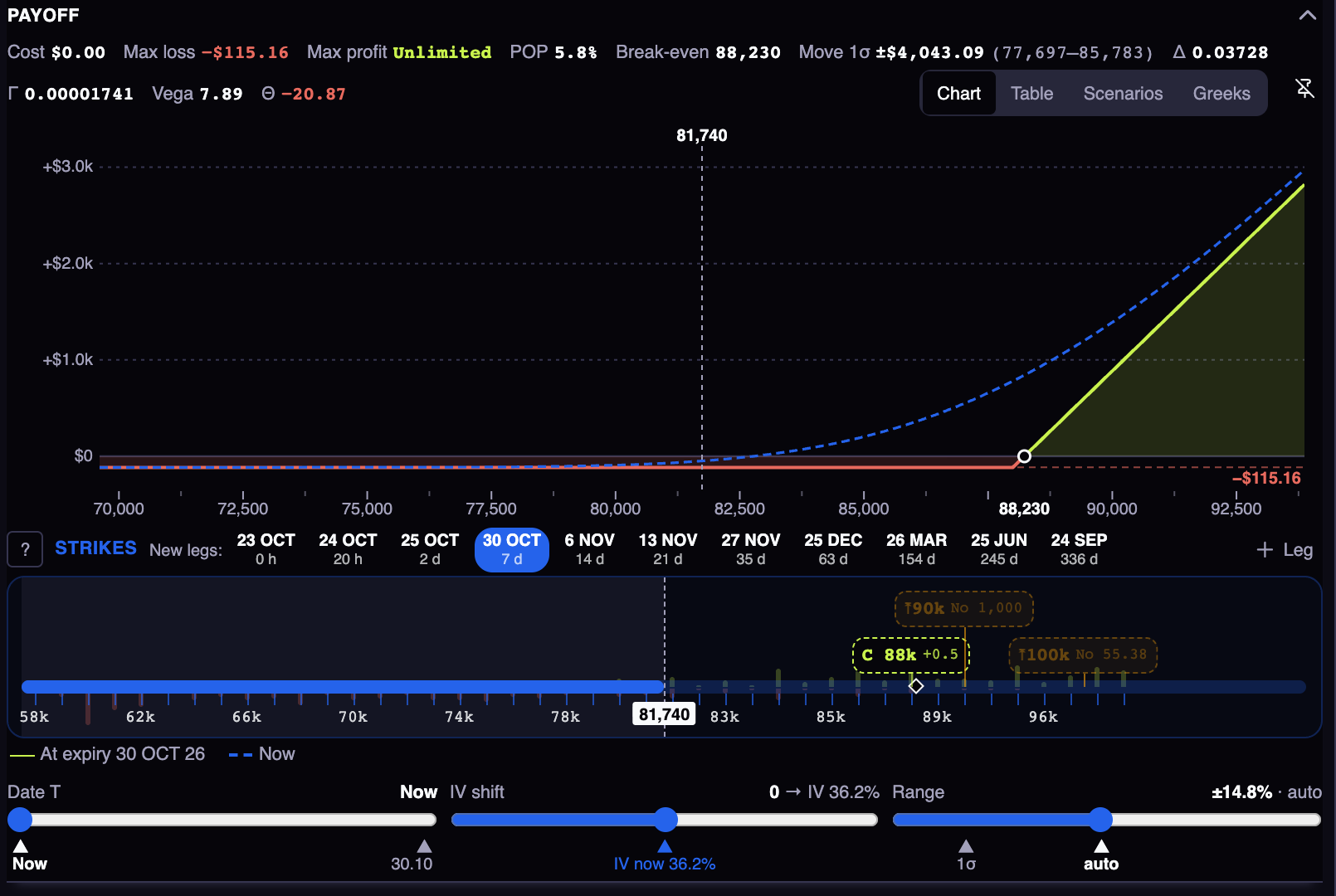 The Polymarket legs are switched off. The call alone loses at most its $115.16 premium, breaks even at 88,230, and has a 5.8% model chance of profit.
This is a cheap lottery ticket. It needs BTC up almost 8% in a week just to break even.
The two “No” legs alone
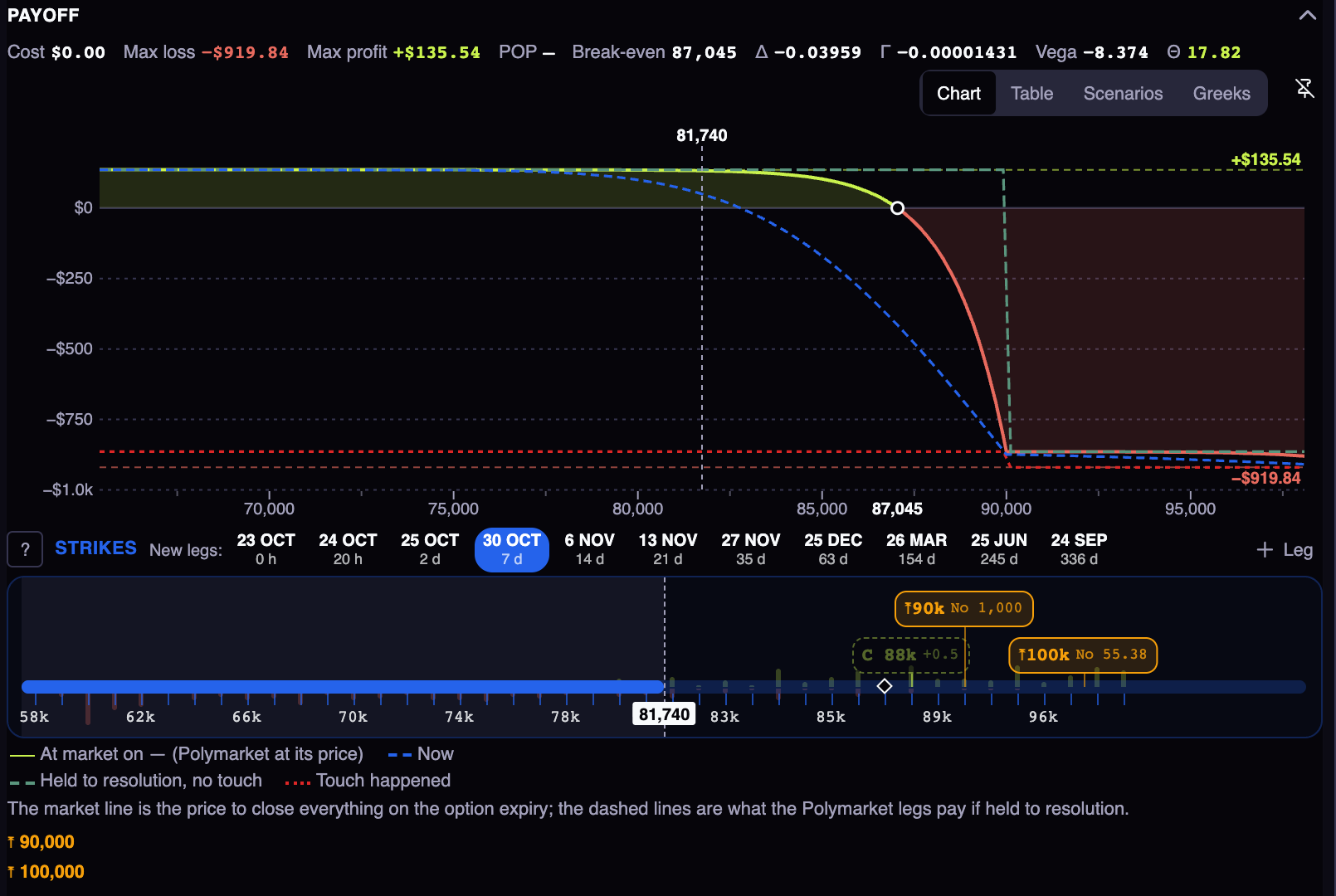 The call is switched off. If BTC never touches $90,000, the “No” legs pay $1,055.38 for $919.84 paid: +$135.54. If it touches both levels, they lose $919.84.
This is the opposite bet. It earns a little if the price stays calm and loses a lot if BTC runs to $90,000. The cliff at 90,000 is the touch.
Together
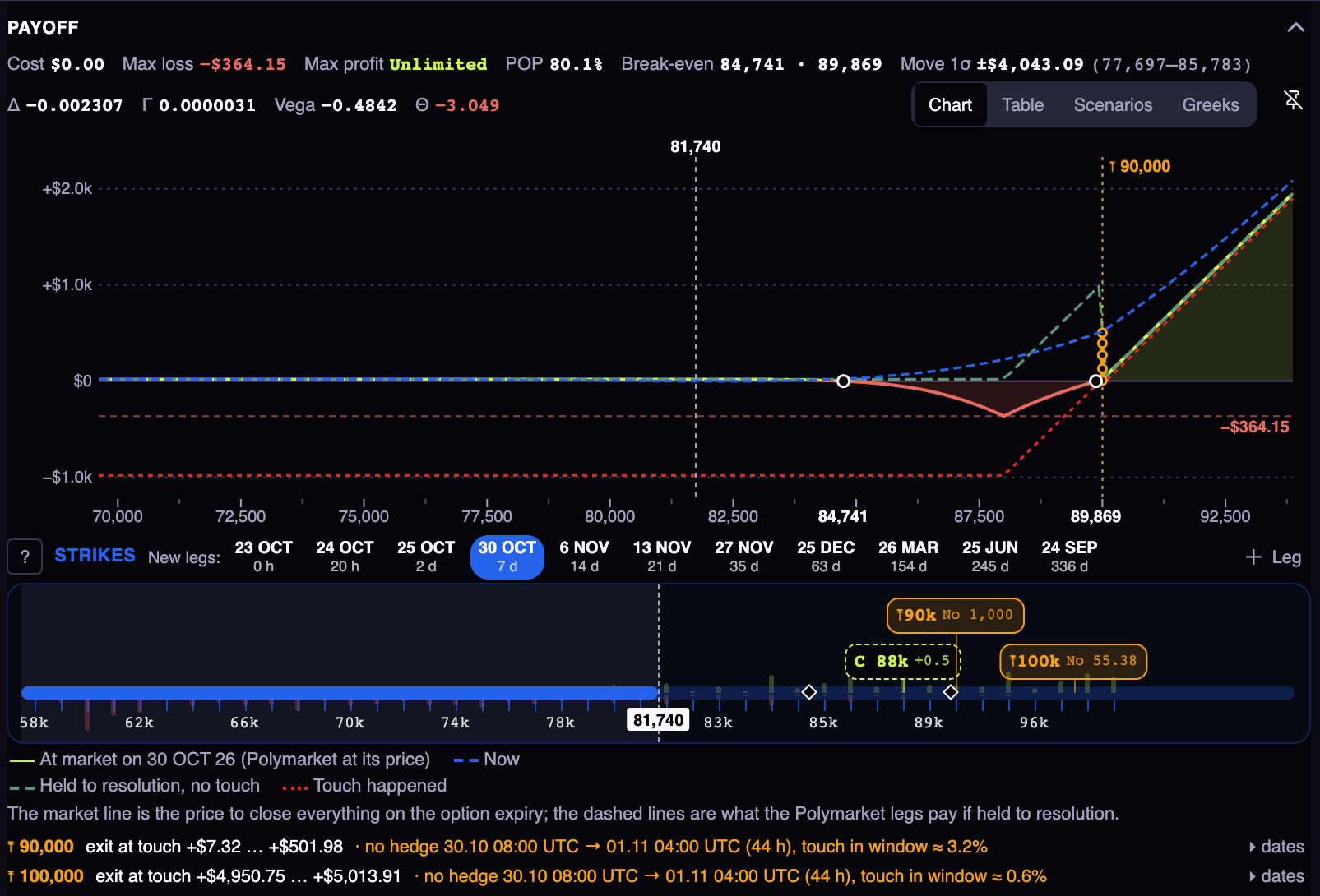 Below about 84,741 the “No” income covers the call’s cost. Above about 89,869 the call’s gain outruns the “No” loss. The loss zone is between them.
How to read it:
- Below 84,741. The call expires worthless (−$115.16). The “No” legs are on track to pay +$135.54. Net about +$20: the heat map shows +$20.4 at every lower price.
- Between 84,741 and 89,869. This is the loss zone, with a worst case of −$364.15. The call is worth little, while the “No” on $90,000 gets cheaper as the price approaches the level.
- Above 89,869. The “No” on $90,000 is lost, but the 0.5 BTC call gains $500 for every $1,000 of rally, so profit is unlimited.
- POP 80.1% comes from the wide flat area below 84,741 where the result is slightly positive. Most outcomes earn a little, and a narrow band loses up to $364.
Touch and resolution lines
Because the Polymarket legs resolve after the options expire, the chart shows more than one “end” line:
| Line | What it shows |
|---|---|
| At market on 30 OCT 26 (Polymarket at its price) (solid) | Close everything on the option expiry. Options at expiry value, “No” legs sold at their model market price. |
| Held to resolution, no touch (green dashed) | Options settle, and you hold the “No” legs until 1 Nov without a touch. They pay $1 per share. |
| Touch happened (red dotted) | The level was touched, so the “No” legs pay nothing. |
| Now (blue dashed) | Today’s value at each price. |
Under the chart, one line per touch leg answers “what if the touch happens and I close the exchange legs right then?”:
- ↑ 90,000: exit at touch +$7.32 … +$501.98. If BTC touches $90,000 and you sell the call at that moment, the result ranges from +$7 to +$502, depending on when the touch happens.
- No hedge 30.10 08:00 UTC → 01.11 04:00 UTC (44 h), touch in window ≈ 3.2%. For 44 hours after the options expire, the “No” is unhedged. The model puts the chance of a touch in that window at about 3.2%. If it happens, the “No” loses and no call is there to pay for it.
- For the $100,000 leg the exit range is +$4,950.75 … +$5,013.91 and the unhedged touch chance about 0.6%.
The note under the touch lines says it plainly: the touch is measured by the market’s rules, and the options are sold at the exchange’s bid at that moment, which can be worse than the model.
Executing a combination with Polymarket legs
- Choose a Polymarket wallet in the window. Polymarket legs are executed only in Build mode.
- Polymarket goes first. It’s a GTC limit order in shares at the book level where your size fills. The exchange legs are sent only if Polymarket fills completely.
- Two venues, not atomic. If Polymarket fills only partly, the rest waits in the book and the exchange legs are held back. You choose Continue: Bybit legs (or your exchange), or close and finish the Polymarket order in the Orders window.
- Polymarket legs loaded from your wallet are for calculation only. You sell them in Portfolio.
Risks specific to these legs
- Different clocks. An option expiry and a Polymarket resolution rarely line up. Check the “no hedge” window before you trade.
- Different price sources. The market may resolve on one exchange’s price while your options settle on another index. Near the level, that difference can decide the outcome.
- Thin books. Many price-level markets trade a few hundred dollars. The picker shows volume per level, and the costs block shows when your size goes deeper than the best price.
- A “No” on a touch market is a short-volatility bet. It earns small amounts most of the time and loses most of its cost in one fast move.