Reconciliation
Updated: 2026-11-14
Your capital went from one number to another. Reconciliation shows why, line by line: what you deposited and withdrew, what closed trades earned, what funding and the platform fee did, and how open positions moved. Whatever the records can’t account for is shown on its own line, Unexplained, and broken down by account. Nothing is hidden or quietly folded into profit.
Where to find it
On the Money desk: New window → Reconciliation, or the Reconciliation preset, which puts it next to Capital and the Journal. The What needs attention window and Home link here when there is an unexplained change.
The market and the period in the desk header apply. Pick 24h, 7d, 30d, 90d or All, and one market or all of them.
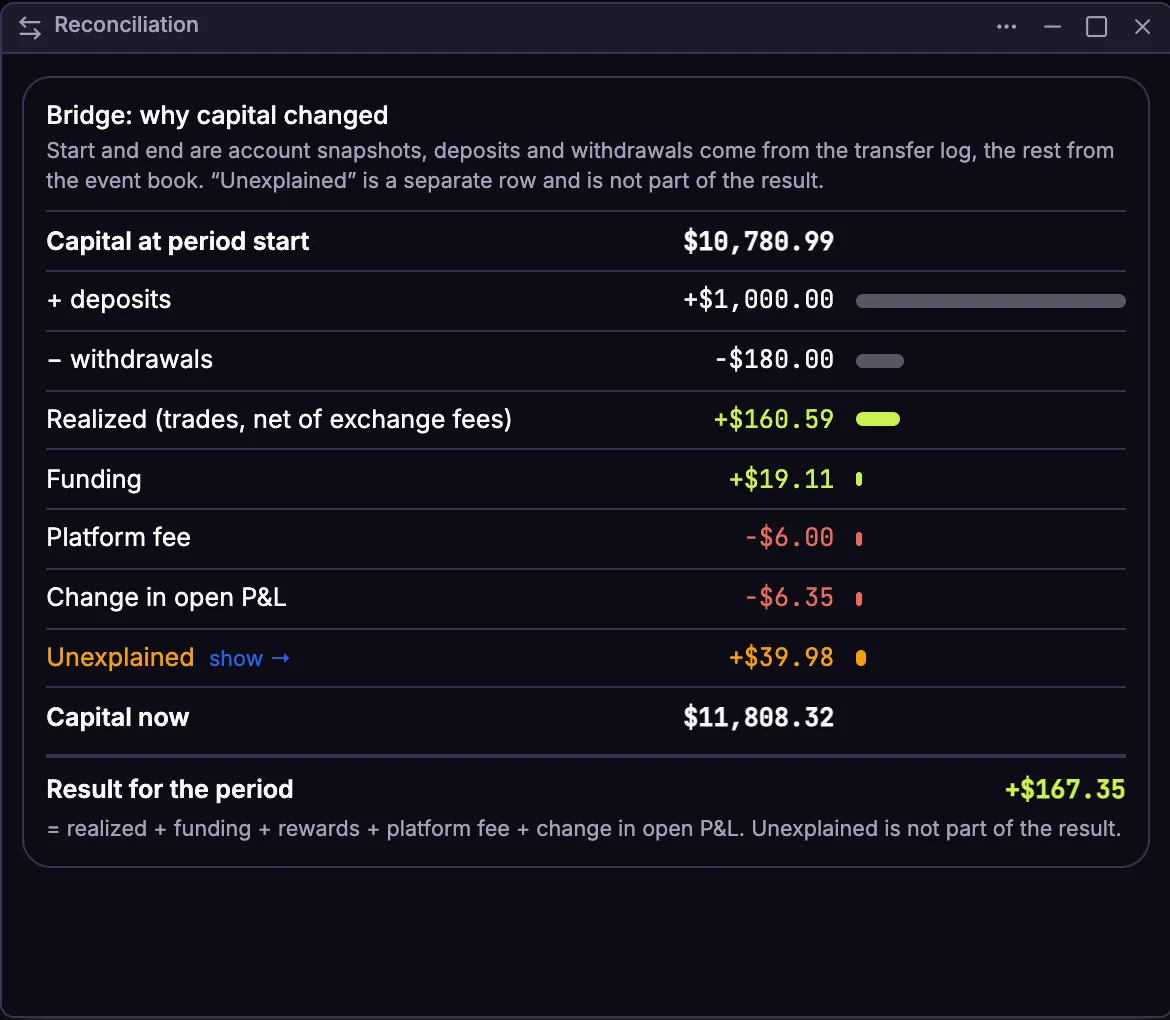 The bridge for 30 days. In the current version the link next to Unexplained reads “by account (N)” and opens the breakdown. Demo numbers.
The bridge
  Capital at period start
+ deposits
− withdrawals
+ Realized (trades, net of exchange fees)
+ Funding
+ Platform fee (a negative number)
+ Change in open P&L
+ Unexplained
= Capital now
Where each line comes from:
| Line | Source |
|---|---|
| Capital at period start, Capital now | Snapshots of every account’s balance. |
| + deposits, − withdrawals | The transfer log of wallets and exchanges. Some moves are estimated (see below). |
| Realized | The trade book: the same closes as in the Journal, net of exchange fees. |
| Funding | Funding payments on perpetual futures, received or paid. |
| Platform fee | The platform’s fee, as a cost. |
| Change in open P&L | Unrealized P&L at the end minus unrealized P&L at the start. |
| Unexplained | Whatever is left. |
Result for the period = realized + funding + platform fee + change in open P&L. Unexplained isn’t part of the result. Deposits aren’t either, so a top-up never looks like profit.
Reading the example
In the screenshot: $10,780.99 + $1,000.00 − $180.00 + $160.59 + $19.11 − $6.00 − $6.35 + $39.98 = $11,808.32. The result for the period is $160.59 + $19.11 − $6.00 − $6.35 = +$167.35. The +$39.98 is money the balances show but no record explains. It isn’t counted as a gain.
What “Unexplained” means
Unexplained is the change in account balances that neither transfers nor book events (trades, funding, fees, open P&L) account for. The Journal doesn’t contain it: the Journal is the explained part.
Click by account (N) next to it to see which accounts diverged from the book, by how much, and the likely cause. In the Reconciliation window the list is open from the start. Each row has Capital → to check that account.
| Cause shown | What it means | What to do |
|---|---|---|
| open P&L unknown at the start or end of the period | The account’s open result wasn’t recorded at one end, so its change lands here. | Usually clears up as snapshots build. Common for accounts connected recently. |
| deposits/withdrawals inferred, not from the exchange history | The exchange didn’t report a transfer, so it was estimated from a balance jump. | Compare with your exchange’s transfer history. If you know it was a transfer, that’s the answer. |
| account connected during the period | The account’s first value counts as money brought in. | Use a period that starts after you connected it. |
| no book events for the period — trades may not have been pulled in | The balance moved, but no trades were recorded for that account. | Check the exchange key’s status on Exchanges & keys. |
| stale snapshot | The latest balance is older than 30 minutes. | Wait for a fresh snapshot, or check the key. |
| book vs exchange: X of Y days match | The trade book and the exchange’s own trades disagree on some days. | That account’s Journal may miss or double a trade on those days. |
| no obvious cause — check deposits and transfers on the exchange | None of the above fits. | Look for transfers between sub-accounts or wallets. |
Events of accounts that aren’t in capital (an archived wallet, a CSV import) are listed separately, because they add to the result without a balance to match.
Notes under the bridge can also tell you:
- how much of deposits and withdrawals is “not from the exchange log”;
- which accounts’ open P&L at the start or end is unknown;
- that the result includes events of accounts not in capital.
Being honest about gaps
The bridge is built from data the venues give us, and that data isn’t perfect:
- Some exchanges don’t report internal transfers, or your key can’t read them. Those moves are estimated from snapshots. An estimate can be wrong either way.
- Snapshots are taken every 15 minutes, so a short spike between two snapshots isn’t seen.
- A small Unexplained amount on a long period is normal. A large one points to a specific account, and the breakdown tells you which.
The bridge never invents a correction. If something doesn’t add up, you see it.
Bridge by source? No.
On the Overview window you can filter by Source, for example only copy bots. A bridge isn’t built for a single source, because one account’s money is shared by several sources. Instead, the window shows what makes up that source’s result.